Waterproof Fiber Cement Board for Wet Rooms, Bathrooms and Basements
Why Terasun TSM fiber cement board outperforms gypsum in wet rooms, shower enclosures, and basement walls. EN 12467 moisture classification explained.
The problem with gypsum board in wet areas
Gypsum board is the default wall substrate across European construction — but it has a fundamental weakness: moisture. Standard gypsum board absorbs water, swells, and loses structural integrity. Even moisture-resistant ('green') gypsum board contains a gypsum core that degrades over time in persistently damp conditions.
Fiber cement board is different. Terasun TSM contains no gypsum. It is an inorganic cement-based product reinforced with fibreglass mesh — the same material technology as fibre cement cladding used on building exteriors for decades.
Moisture performance under EN 12467
EN 12467 — the European standard governing flat fibre cement sheets — classifies products by their moisture behaviour. Terasun TSM is CE certified under this standard with certificate 1023-CPR-1565 P.
| EN 12467 Property | Terasun TSM Performance |
|---|---|
| Moisture movement | ≤ 1.0 mm/m (Category A) |
| Water absorption | Low — mineral matrix |
| Freeze-thaw resistance | Tested (Category A climate) |
| Dimensional stability | Maintains shape when wet |
| Reaction to biological agents | Not susceptible to mould growth |
Category A under EN 12467 covers high-humidity interior environments and exterior exposure. This is the highest moisture classification in the standard.
Where to use fiber cement board instead of gypsum
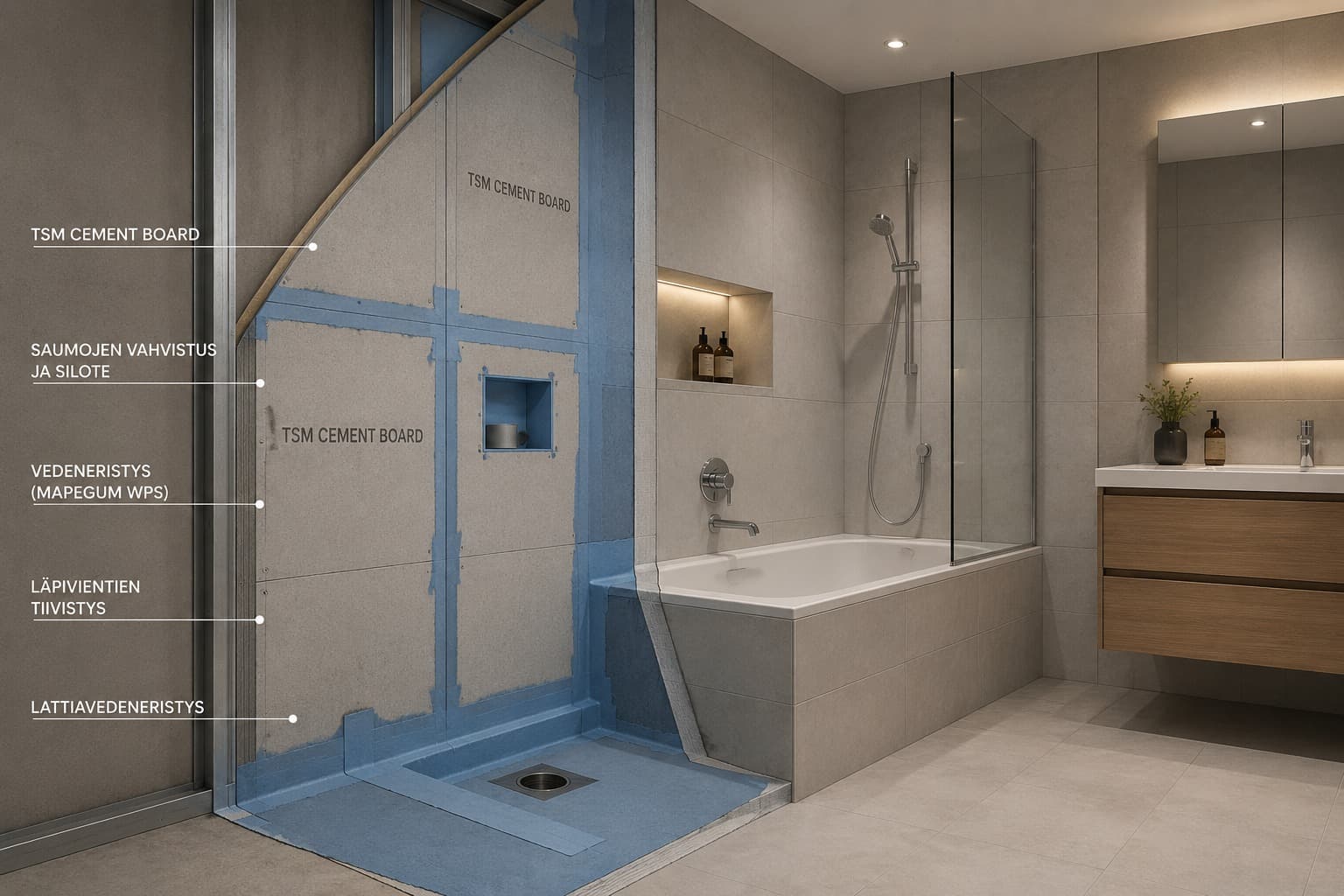
Shower enclosures and wet rooms
The most common misapplication in European construction is using standard gypsum board (even tile-backer variants) as the substrate behind shower tiles. In a properly functioning shower, the substrate is exposed to continuous moisture vapour and periodic direct water contact at joints.
- Use Terasun TSM 12 mm as the wall substrate behind tiles
- Apply a liquid tanking membrane (bitumen or acrylic) in the critical zone (floor-to-900 mm)
- Use C2 flexible adhesive for tiles on fiber cement
- Seal all board joints and corners before tiling

Fiber cement board installed in wet room shower enclosure
Bathrooms (non-shower areas)
For areas outside the direct shower zone — above vanities, around baths, behind WCs — fiber cement board provides peace of mind against humidity cycling without the premium cost of tanking the entire room.
Basement and below-grade walls
Basement walls are susceptible to condensation, rising damp, and occasional water ingress. Gypsum board fails rapidly in these conditions — fiber cement board does not. Terasun TSM is suitable for basement fit-out where the structure is waterproofed externally or internally to prevent bulk water ingress.
Fiber cement board does not replace structural waterproofing. Where hydrostatic pressure exists, the concrete or masonry structure must be waterproofed first. TSM board provides the interior lining layer only.
Utility rooms and plant rooms
Laundry rooms, boiler rooms, and plant spaces with high humidity benefit from fiber cement board over gypsum — particularly where steam or condensation is expected from equipment operation.
Request a free board sample
Evaluate surface finish, weight, and cut behaviour before specifying. CE documentation included.
Comparison: wet room substrate options
| Substrate | Water resistance | Tile-ready | Mould risk | CE marked | Typical cost |
|---|---|---|---|---|---|
| Standard gypsum | Poor | Yes | High | Yes | Low |
| Moisture-resistant gypsum | Moderate | Yes | Moderate | Yes | Low–medium |
| Terasun TSM (fiber cement) | Excellent | Yes | Very low | Yes | Medium |
| Calcium silicate board | Excellent | Yes | Very low | Varies | Medium–high |
| Cement render on block | Excellent | Slow | Very low | N/A | High (labour) |
Installation guidance for wet room applications
Board preparation
- Cut Terasun TSM with a scoring tool or angle grinder (score and snap method works for straight cuts)
- Wear a dust mask when cutting — cement dust is an irritant
- Seal cut edges with a suitable primer before installation in wet zones
Fixing to timber or steel frame
- Use corrosion-resistant screws (A2 stainless or hot-dipped galvanised)
- Fix at 200–250 mm centres within 25 mm of board edges
- Leave 3–5 mm expansion gap at floor and adjacent walls
- Fill board joints with flexible jointing compound or cover with alkali-resistant fibreglass tape before tiling
Tiling onto fiber cement
- Prime the board surface before applying tile adhesive (check adhesive manufacturer's recommendation)
- Use C2 or C2S1/S2 flexible adhesive
- Install tiles normally — no special tooling required
- Apply silicone sealant to all movement joints, internal corners, and the floor/wall junction
Related applications
Request a project quotation
CE-certified TSM board, direct from factory to your project or warehouse across Europe.
Become a distributor in your market
Most European markets are open. Territory exclusivity available for qualified distributors.
Technical documents
Frequently asked questions
Is Terasun TSM fully waterproof?
Terasun TSM is moisture-resistant per EN 12467, meaning it is dimensionally stable when wet and will not degrade, swell, or lose integrity in humid conditions. It is not a membrane — a separate waterproofing layer (liquid membrane or sheet) must be applied in shower enclosures and areas of direct water contact per building regulations.
Can fiber cement board be tiled directly?
Yes. Terasun TSM provides a stable, hard substrate for ceramic and porcelain tiles. Use a flexible tile adhesive suitable for cement board substrates (C2 or better). Grout joints and the board-to-floor junction should be sealed with silicone or tanking system before tiling.
What is the EN 12467 moisture classification?
EN 12467 is the European standard for flat fiber cement sheets. It classifies boards into climate categories: Category A = suitable for high-humidity conditions. Terasun TSM meets the requirements for use in Category A environments, confirming suitability for wet rooms and exterior applications.
How does TSM compare to moisture-resistant gypsum board (green board)?
Moisture-resistant gypsum board ('green board') is improved over standard gypsum but still contains gypsum core, which absorbs moisture over time and can fail in prolonged wet conditions. Fiber cement board contains no gypsum — it is an inorganic mineral product that maintains its properties when wet. For shower enclosures and below-grade applications, fiber cement is the technically superior choice.