Fiber Cement Board with Underfloor Heating: Stable Substrate for UFH Systems
How to use Terasun TSM fiber cement board as a substrate over underfloor heating. Thermal conductivity, expansion, and compatibility with tile and screed systems.
Why substrate choice matters with underfloor heating
Underfloor heating (UFH) systems cycle through temperature changes daily — warming up and cooling down as the heating runs. This thermal cycling creates movement in the floor build-up. A poor substrate choice — one that moves, creaks, or fails to distribute loads evenly — causes tile cracking, adhesive failure, and costly remediation.
Fiber cement board is an increasingly specified substrate for tiled floors over UFH because it is:
- Dimensionally stable under temperature cycling
- Rigid — does not flex or telegraph movement from below
- Non-combustible — safe in contact with low-temperature heating systems
- Compatible with all tile adhesives rated for UFH
Thermal properties of Terasun TSM board
For underfloor heating applications, thermal conductivity is important — the substrate should conduct heat upward rather than insulate it downward.
| Property | Value |
|---|---|
| Thermal conductivity (λ) | ~0.4 W/(m·K) |
| Thermal expansion | Low — mineral matrix |
| Maximum operating temperature | Up to 70°C (standard UFH is 35–55°C) |
| Non-combustible | Yes — inorganic cement board |
| Acoustic benefit | Some — mass-based damping |
The thermal conductivity of fiber cement board (λ ≈ 0.4 W/m·K) is significantly higher than timber (λ ≈ 0.13 W/m·K) and comparable to screed. This means less heat is trapped beneath the board.
UFH system types and board installation
Wet UFH in screed
The most common European installation. UFH pipes are embedded in a flowing or semi-dry screed. Once the screed is cured and dried:
- Prime the screed surface with a suitable primer
- Fix Terasun TSM 12 mm board with corrosion-resistant screws or tile adhesive bed
- Allow expansion gaps: 5 mm at all walls and fixed elements, 3 mm at board joints
- Tape joints with alkali-resistant fibreglass mesh tape, bed in flexible adhesive
- Prime board surface before tiling
- Tile with C2S1 flexible adhesive suitable for UFH
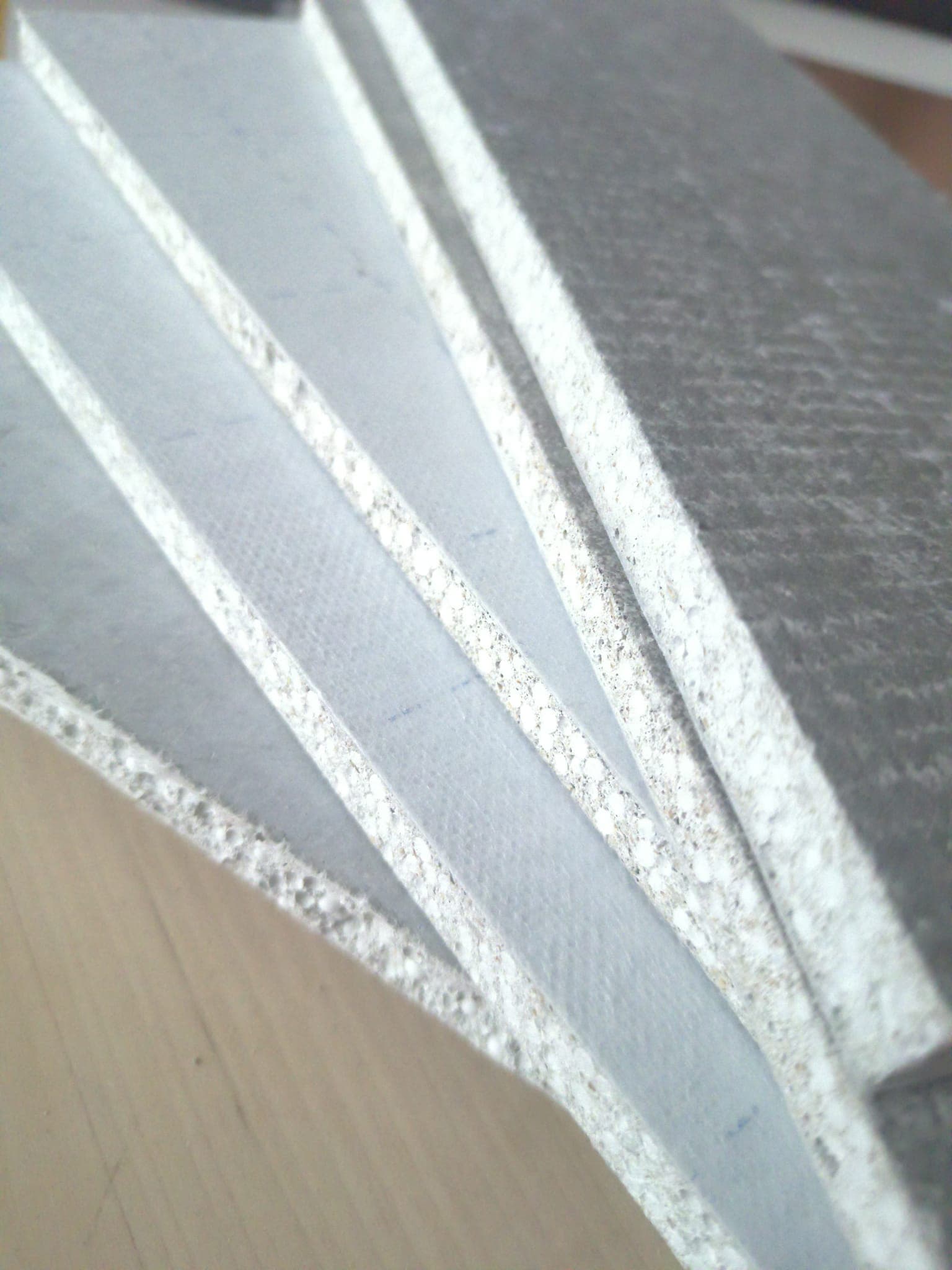
Fiber cement board installation over screed underfloor heating system
Dry UFH systems (grooved panels)
Dry UFH uses grooved lightweight panels (typically polystyrene or wood composite) with aluminium heat spreaders. The fiber cement board sits on top as the final structural topping before tiling:
- Install grooved UFH panels with heat spreaders as manufacturer specifies
- Lay Terasun TSM 12 mm board over the UFH panel system
- Fix boards with screws penetrating into the subfloor — avoid UFH pipe locations
- Critical: mark pipe locations on board before fixing to avoid screw damage
- Proceed with tiling as above
Suspended timber floor with UFH
Fiber cement board adds mass and rigidity to timber suspended floors — improving heat distribution and reducing bounce. However:
- Ensure the joist and board system can support the combined dead load (TSM 12 mm = 9.96 kg/m²)
- Use floating or screwed installation depending on UFH pipe routing
- Maintain perimeter gaps — timber floors expand seasonally, and this movement must not transfer to the board-tile assembly
Avoiding cracking: the three rules
Rule 1: Expansion gaps Leave a minimum 5 mm gap at all walls, doorframes, and fixed elements. Cover with skirting. In large floor areas (>8 m in either direction), introduce additional movement joints every 6–8 m.
Rule 2: Flexible adhesive Use C2S1 or C2S2 adhesive. Standard cement-based adhesive (C1) is too rigid for UFH applications. This applies to both board-to-substrate and tile-to-board adhesive where used.
Rule 3: Commission UFH correctly Before tiling, commission the UFH system according to the screed manufacturer's commissioning protocol — typically a gradual temperature increase over 7 days. Do not tile over a freshly poured screed or before commissioning is complete.
Request a free board sample
Evaluate surface finish, weight, and cut behaviour before specifying. CE documentation included.
Thickness selection for floor applications
| Application | Recommended thickness | Notes |
|---|---|---|
| Light domestic (apartment) | 12 mm | Standard specification, CE documented |
| Commercial — heavy foot traffic | 15–18 mm | Increased rigidity for loads |
| Over battens (raised floor) | 18 mm | Span between battens up to 600 mm |
| Renovation over existing floor | 6–8 mm | Check door clearances |
The 12 mm CE-marked specification is the primary documented thickness. For other thicknesses, contact Terasun Europe to confirm availability and applicable technical data.
Wet room floors: the critical detail
In wet room shower areas where the floor is also tiled and water-exposed, the substrate choice is even more critical. Fiber cement board provides:
- No swelling when wetted — unlike timber or gypsum substrates
- Stable base for the waterproof tanking membrane applied before tiling
- No biological degradation in persistently wet conditions
For wet room floor applications: 1. Install TSM board over screed or concrete floor deck 2. Apply liquid waterproof membrane over entire wet room floor and 200 mm up the walls 3. Reinforce membrane at floor-wall junctions with tape 4. Tile with C2S2 flexible adhesive 5. Grout with epoxy grout for maximum water resistance
Related pages
Request a project quotation
CE-certified TSM board, direct from factory to your project or warehouse across Europe.
Become a distributor in your market
Most European markets are open. Territory exclusivity available for qualified distributors.
Technical documents
Frequently asked questions
Can fiber cement board be used directly over underfloor heating pipes?
Terasun TSM should be installed over a screed or structural floor deck, not directly over UFH pipes without an intermediate layer. Where pipes are embedded in a screed, the board is fixed to the screed surface. Where pipes are in a dry system (grooved panels), the board acts as the topping layer — always check the UFH system manufacturer's screed or topping requirements.
Will underfloor heating cause fiber cement board to crack?
No, provided expansion gaps are maintained around the perimeter of the board installation (typically 5–8 mm to walls and fixed elements) and at regular intervals in large areas. Fiber cement has a low thermal expansion coefficient — it is dimensionally stable under normal UFH operating temperatures (typically 35–55°C flow temperature).
What tiles can be laid on TSM board over UFH?
All standard ceramic and porcelain tiles can be used. Use a flexible tile adhesive (C2S1 or C2S2 classification per EN 12004) rated for UFH applications. Flexible adhesive accommodates the small movement caused by thermal cycling without cracking.
Is a membrane needed between the board and tiles on UFH?
A membrane is not always required, but is recommended in large tile formats (>600×600 mm) over UFH to decouple the tiles from the board and accommodate differential thermal movement. Consult the tile adhesive manufacturer for specific guidance.