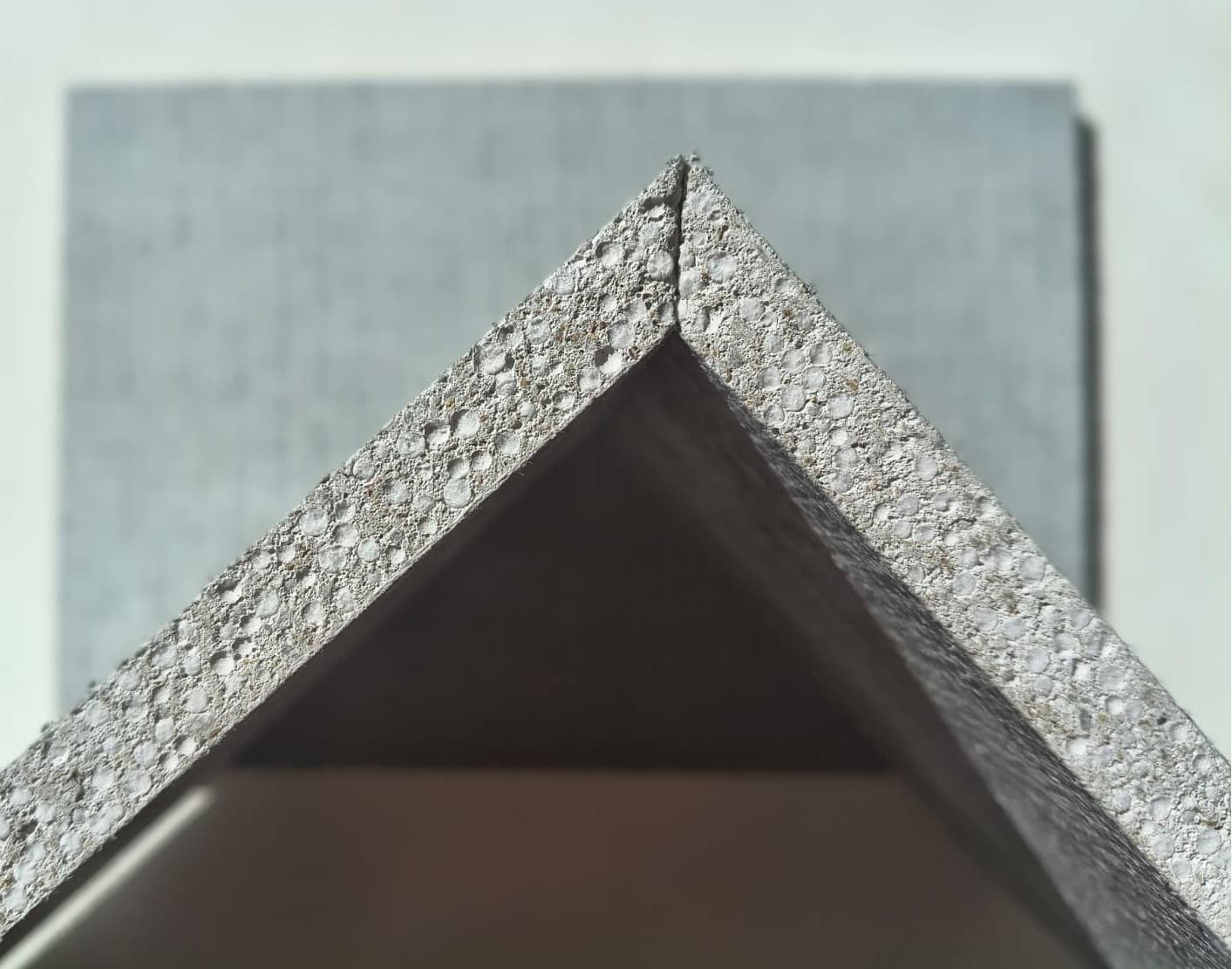
Terasun TSM: Cement Boards and Fire-Resistant Construction
Terasun TSM has an A1 reaction-to-fire class for the tested 12 mm specimen and a tested non-load-bearing partition classified E120 / EI90 / EW120. This page explains what each result covers.
Reaction to fire
Class A1
12 mm specimen — Intertek, EN 12467:2012
Tested partition
E120 / EI90 / EW120
FIRES-CR-284-25-AUPE, EN 13501-2:2023
Tested assembly
C100×45×0.6 mm
12 mm TSM both sides · studs up to 600 mm · 100 mm mineral wool
Height
Up to 4000 mm
Only with classification reduced to E90/EI90/EW90
Fire Safety: Material Reaction to Fire and Structural Fire Resistance
When selecting a cement board for fire protection, it is important to distinguish between two key parameters: the material’s reaction to fire (how the board itself behaves when exposed to flames) and the fire resistance rating of the entire assembly (how long a constructed wall or partition maintains its structural integrity and thermal insulation capacity). These parameters are governed by distinct European standards and are not interchangeable within project documentation. Terasun TSM Cement Board is supported by product documentation (ETA 24/0895, CE 1023-CPR-1565 P, DoP TRS-20250610F) as well as a separate classification report for a specific tested partition (FIRES-CR-284-25-AUPE) — the former addresses the product itself, while the latter details the performance of the assembled structure under fire conditions.
Reaction to Fire Class A1: What It Means for TSM
An Intertek document for a 12 mm thick Terasun sample specifies a reaction-to-fire classification of A1 according to EN 12467:2012. This is the highest category under the European classification system, indicating that the material does not contribute to the development of a fire—neither during the ignition phase nor during the spread of the flames. The A1 classification cannot be automatically applied to all product thicknesses or to boards with applied finishes (such as plaster or paint), as these are tested as part of a separate system. In inquiries for “fire-resistant cement board” or “non-combustible board,” two distinct properties are often conflated: the material’s reaction to fire (Class A1) refers to the individual board, whereas the fire resistance of a wall (classified as E, EI, or EW, followed by a duration in minutes) refers to the entire assembled structure, including the framing, insulation, and fasteners. A material that is classified as non-combustible in terms of its reaction to fire does not automatically guarantee any specific fire-resistance rating for a finished wall; such a rating must be verified through a separate test of the complete assembly.
Tested Partition: E120 / EI90 / EW120
Classification report FIRES-CR-284-25-AUPE, issued in accordance with EN 13501-2:2023, confirms E120, EI90, and EW120 ratings for a specific non-load-bearing, insulated partition. The tested assembly utilizes C100×45×0.6 mm steel profiles with a stud spacing of up to 600 mm, 12 mm TSM boards on both sides of the frame, and 100 mm thick mineral wool within the cavity. These specifications apply exclusively to this particular assembly and cannot be generalized to other wall configurations using TSM. E (Integrity) refers to the ability to prevent the passage of flames and hot gases through cracks or gaps; I (Insulation) refers to limiting the temperature rise on the unexposed side; and W (Radiation) refers to limiting thermal radiation on the unexposed side. Consequently, an EI90 rating indicates that the assembly maintains both its integrity and thermal insulation capacity for 90 minutes, under the conditions defined in the report.
Scope of Application: Permitted and Prohibited Modifications
The FIRES report outlines the permitted modifications: increasing the partition height up to 4000 mm is allowed only if the classification is reduced to E90/EI90/EW90; the maximum stud spacing within the scope of application is 600 mm; and the installation of electrical sockets or switches within the classified assembly is not permitted without a separate, specific assessment. Any deviation from the described assembly—such as a change in board thickness, profile type, insulation material, or fastener spacing—falls outside the scope of the verified classification, requiring either a separate evaluation based on the full text of the report or new fire testing. If a project requires a different classification, height, or framing configuration, please consult Terasun Europe to confirm whether the existing report remains applicable.
Where Are Fire-Resistant Cement Boards Used?
TSM boards may be suitable for non-load-bearing partitions, technical rooms, evacuation corridors, and framed structures where the project requires a certified fire rating. The specific class required is always determined by the building’s intended use and the overall project design; for instance, an EI90 rating for a tested partition does not automatically apply to TSM-clad columns, suspended ceilings, or utility shafts. A search for a “fire protection board for steel frame” requires further clarification: a fire test for a non-load-bearing partition cannot serve as proof of fire protection for load-bearing steel columns or beams. The latter are subject to different standards—specifically the “R” criterion for load-bearing capacity—and require separate testing or engineering calculations. Similarly, the fire rating of a vertical partition does not validate the fire resistance of a ceiling, floor slab, or facade system, as each of these elements is governed by its own specific requirements and testing protocols.
Fire Safety Documentation for TSM Cement Board
The primary document for the partition system is FIRES-CR-284-25-AUPE, which details the tested assembly, its classification, and the scope of its application. Additionally, the product is covered by ETA 24/0895 and CE certificate 1023-CPR-1565 P. Regarding reaction to fire, a 12 mm specimen has been assessed by Intertek in accordance with EN 12467:2012, achieving an A1 classification. Before publishing or sharing the full FIRES report with third parties, please ensure compliance with the reproduction terms specified within the document itself.
For Architects and Designers: Construction, Thickness, and Certificates
Tested construction (E120/EI90/EW120): C100×45×0.6 mm profiles, stud spacing up to 600 mm, 12 mm TSM boards on both sides, 100 mm mineral wool — FIRES-CR-284-25-AUPE.
Permissible height adjustment: up to 4000 mm (with a revised classification of E90/EI90/EW90); any other modifications are subject to the full test report.
Electrical sockets and switches: not permitted within the classified assembly without a specific, separate solution.
Reaction to fire: Class A1 for 12 mm boards (per Intertek EN 12467:2012) — applies to the material itself, not the completed wall assembly.
Certificates: ETA 24/0895, CE 1023-CPR-1565 P, DoP TRS-20250610F, and test report FIRES-CR-284-25-AUPE — available upon request from Terasun Europe.
Requesting Fire Safety Certificates and Technical Documentation
For technical approval, tender documentation, or preparation for project certification, please contact Terasun Europe. Please specify:
- Type of construction
- Required fire resistance rating
- Height of the structure
- Project country
Frequently Asked Questions about TSM Cement Board Fire Safety
Is TSM a non-combustible board?
The tested 12 mm sample is classified as A1—the highest category for reaction to fire. It is important to distinguish this material property from the fire resistance rating of a completed assembly.
Can an EI90 rating be claimed for any installation using TSM?
No. The EI90 classification applies exclusively to the specific assembly detailed in the FIRES-CR-284-25-AUPE report, including any variations permitted therein.
Can one layer of the board be replaced with a different brand?
No, unless such a substitution is explicitly covered by the scope of the report or supported by a separate assessment; the classification applies to the assembly as a whole.
Are electrical sockets and switches permitted in an EI90 wall?
The classification report does not allow for their inclusion in the tested assembly without a separate, specific evaluation.
Is TSM suitable for the fire protection of load-bearing steel columns?
The existing report pertains to non-load-bearing partitions; fire protection for columns and beams requires a separate assessment based on standards for load-bearing structural elements.
Consultation and Technical Documentation
Terasun Europe is a division of PlanX Oy, responsible for the supply of TSM Cement Board in Europe. Please contact us at info@terasun-europe.eu, providing the project location (country), construction type, board thickness, and estimated quantity. We will assist you in obtaining the necessary technical documentation (ETA, DoP, EPD, and fire resistance reports) for your project.
Related pages