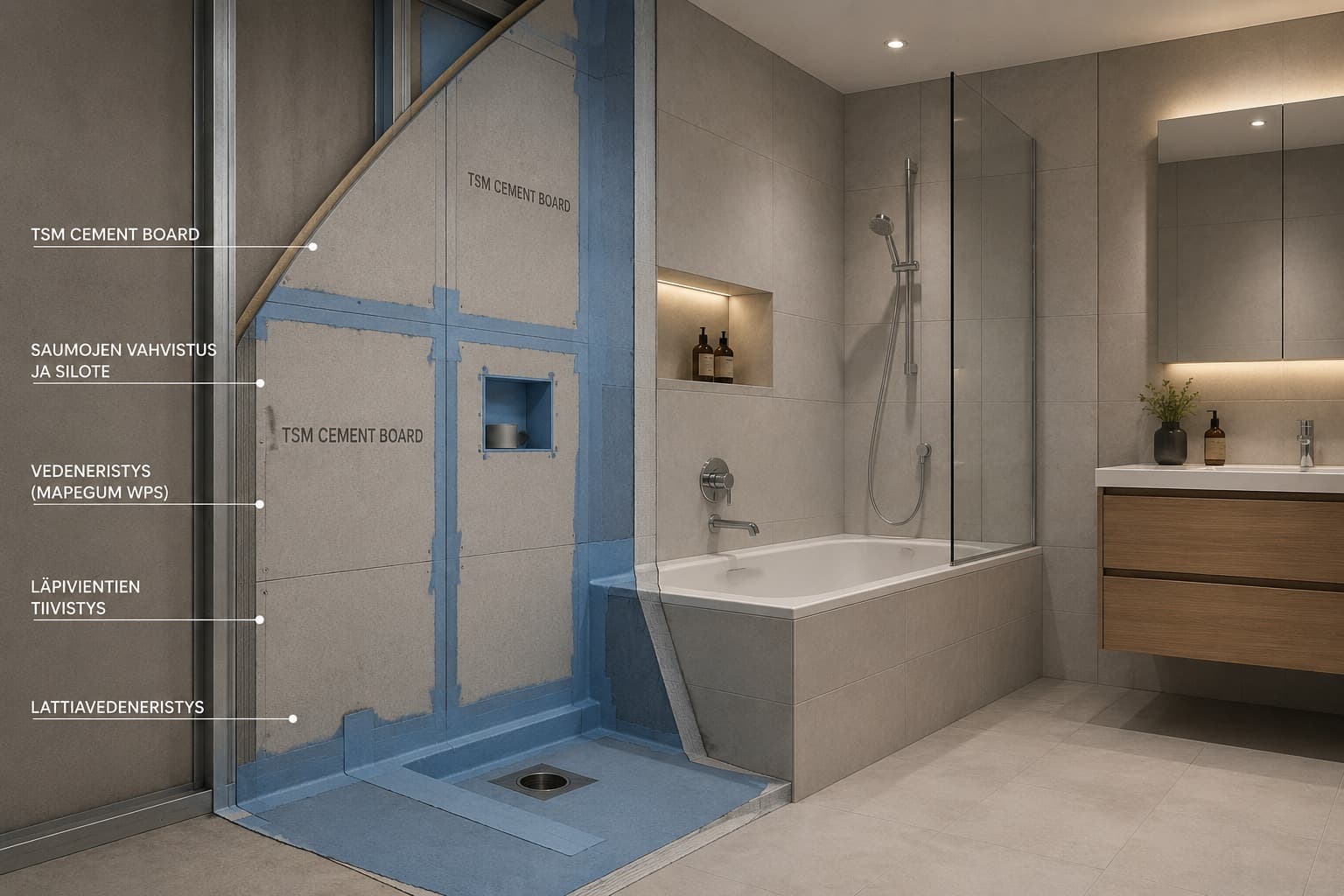
Terasun TSM Cement Boards for Bathrooms, Showers, and Wet Rooms
Terasun TSM is a lightweight, mineral-based cement board for walls and partitions in bathrooms, showers, laundry rooms and other high-humidity spaces, used together with a separate waterproofing system.
Substrate
Mineral, paper-free
Cementitious matrix, fiberglass mesh, water and EPS granules (EPD-IES-0018268)
Waterproofing
Separate layer
Membrane or liquid-applied coating over the board in wet zones
Weight
9.96 kg/m²
12 mm board, 1200×2400 mm format (EPD-IES-0018268)
Thickness
3–30 mm
Supplier range; standard 1200×2400 mm, lengths up to 3000 mm
Cement-Based Substrate for Wet Areas
Terasun TSM Cement Board is a lightweight cement board designed for use in walls and partitions within bathrooms, restrooms, shower enclosures, laundry rooms, and other high-humidity spaces. According to EPD-IES-0018268, the board consists of a cementitious matrix, fiberglass mesh, water, and EPS granules—a mineral-based composition rather than an organic one. This distinction is a common reason for choosing cement boards over paper-faced alternatives. When used in wet areas, these boards must always be paired with an appropriate waterproofing system; a moisture-resistant mineral substrate does not, on its own, waive local building code requirements for watertightness in areas subject to direct water exposure.
Cement board for bathrooms and showers: tested with Kiilto waterproofing
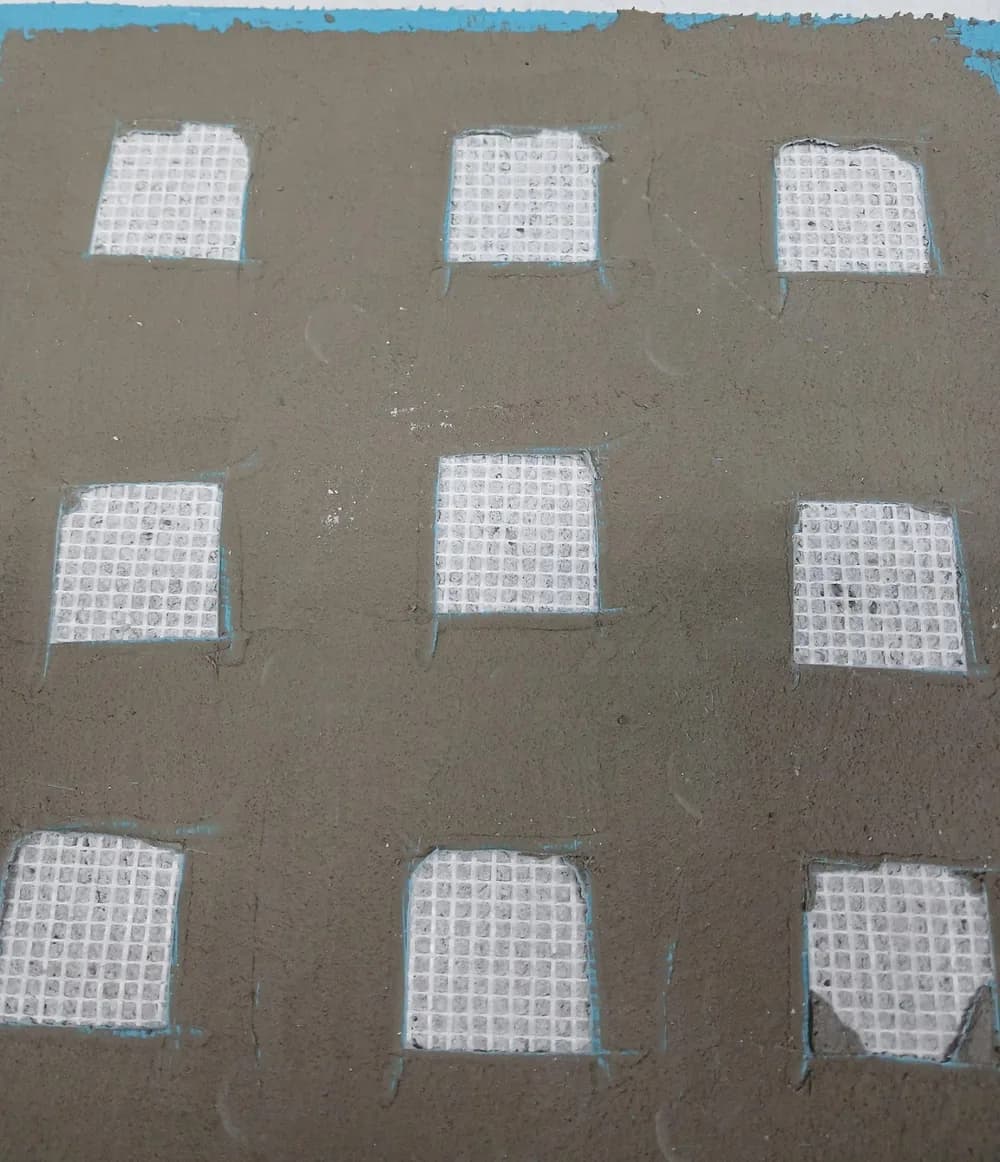
Choosing a cement board for a bathroom, shower or other wet room? The key question is whether waterproofing and tiles will hold firmly on the board. Kiilto, the Finnish maker of waterproofing and tile adhesives, tested three of its waterproofing systems on TSM cement board. In all three tests, the break ran through the board, not through the waterproofing.
For buyers, this is the key point: bathroom wall waterproofing on TSM can be done with tested Kiilto systems.
0.38 N/mm²
waterproofing bond to the board
100 %
break in the board, not in the waterproofing
3 of 3
Kiilto systems tested
A1
non-combustible board, EN 13501-1
Waterproofing test results on TSM cement board
| Kiilto waterproofing | Type | Consumption | Bond | Break |
|---|---|---|---|---|
| KeraPro | Typefast-drying | Consumption1.0 kg/m² | Bond0.38 N/mm² | Break100 % in the board |
| Keramix | Typetwo-component | Consumption1.5 kg/m² | Bond0.38 N/mm² | Break100 % in the board |
| Kerafiber | Typefibre-reinforced | Consumption0.8 kg/m² | Bond0.29 N/mm² | Break100 % in the board |
Build-up: Kiilto KeraPrimer primer + waterproofing + Kiilto Flexfix tile adhesive
What the pull-off test shows
In a pull-off test, a dolly is glued to the waterproofing and pulled until failure. This measures the adhesion of waterproofing to the substrate. If the break runs through the board rather than along the interface with the waterproofing, the bond was not the weak point. This was the case in all three tests. According to Kiilto’s written assessment, the results are of the same order as for similar fibre cement boards.
Cement board for tiles and porcelain stoneware
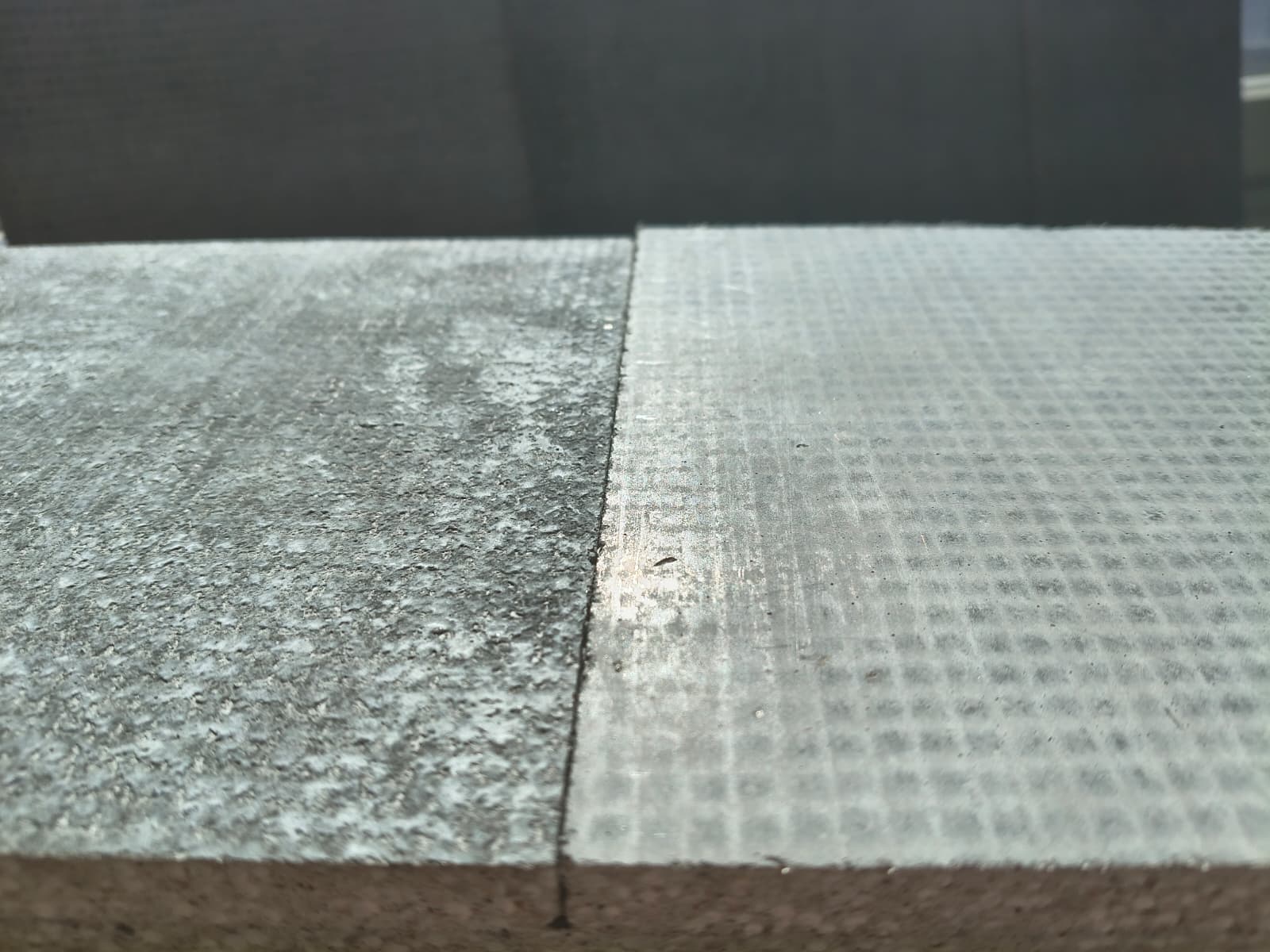
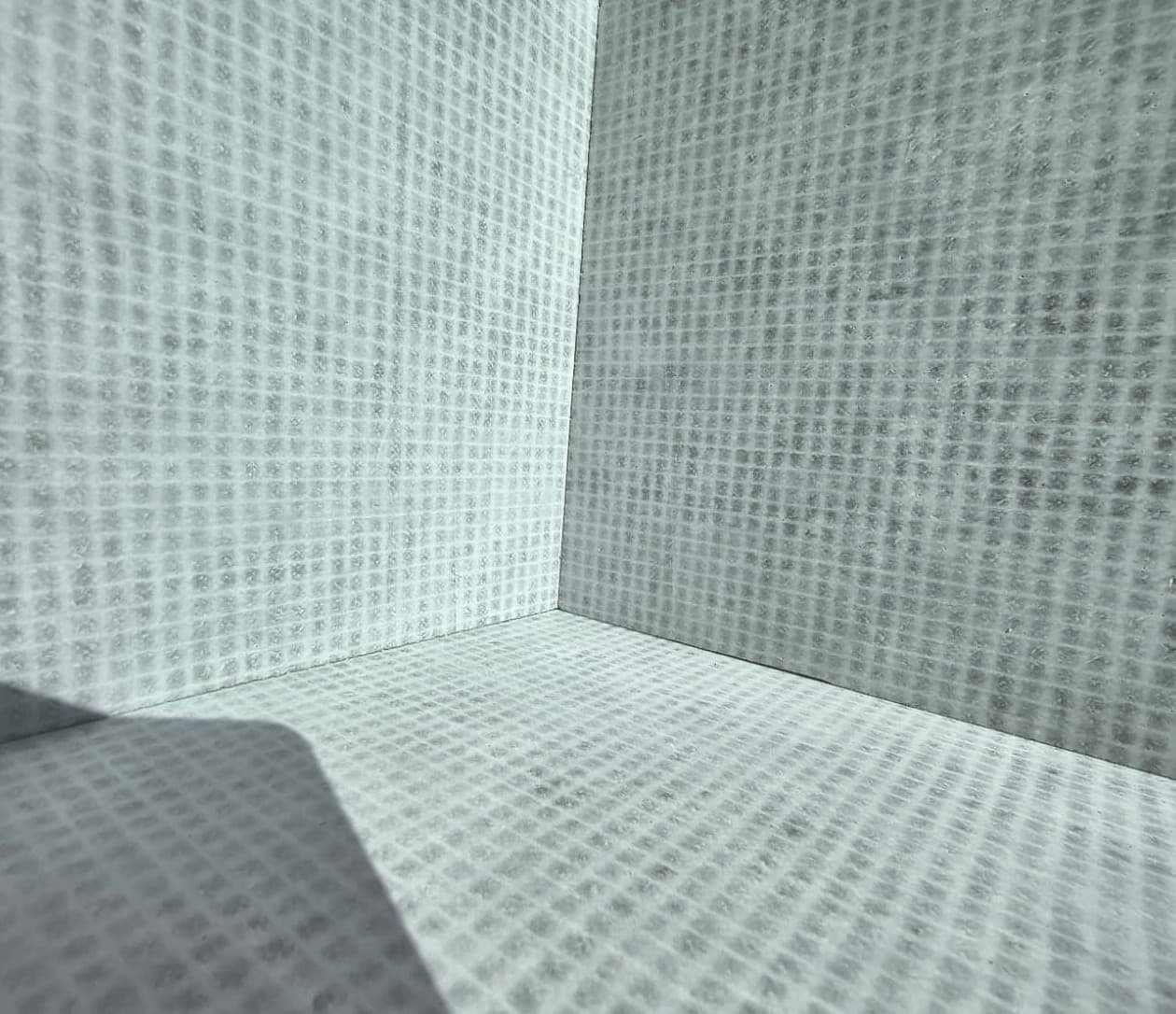
Tile backer board for tiles and porcelain. A cement core with glass-fibre mesh on both faces gives a rigid substrate for tiling with tile adhesive.
Cement-based board with no paper facing. An alternative to moisture-resistant plasterboard in bathroom and shower wet zones.
Non-combustible bathroom board. Reaction to fire class A1 per EN 13501-1 (ETA 24/0895).
Practical sheet size. 1200 × 2400 mm sheet, thickness 6–18 mm per ETA. 12 mm is most common for bathroom walls.
European documents. ETA, CE certificate, DoP and EPD for projects and tenders.
Where to use TSM cement board
- Bathrooms and shower walls
- Toilets and utility rooms
- Sauna washrooms and laundry rooms
- Modular bathroom pods and prefabricated bathrooms
- Bathroom renovation in apartments and houses
- Wet rooms in timber frame and light steel frame (LGSF) buildings
- Hotels, apartment buildings, swimming pool changing rooms
Bathroom wall waterproofing on TSM cement board
Board the frame with TSM cement boards and treat the joints.
Apply the Kiilto KeraPrimer waterproofing primer.
Apply Kiilto liquid waterproofing — KeraPro, Keramix or Kerafiber — at not less than the tested consumption. Reinforce corners, joints, pipe penetrations and the floor drain.
Once the waterproofing has dried, lay tiles or porcelain stoneware with Kiilto Flexfix tile adhesive.
Follow the manufacturer’s instructions at every step.
Which waterproofing goes on cement board in a bathroom?
Three Kiilto liquid waterproofing systems have been tested on TSM cement board: KeraPro, Keramix and Kerafiber with KeraPrimer. In every test, the break ran through the board, not through the waterproofing.
Can TSM cement board be used as a tile backer in a shower?
Yes, as a substrate for waterproofing and tiles. The bond of the tested Kiilto systems to the board was 0.29–0.38 N/mm².
What board to use on bathroom walls for tiles?
Cement board is used on bathroom and shower walls under tiles. TSM cement board is non-combustible (A1), has no paper facing and has been tested with Kiilto waterproofing.
What thickness of cement board for bathroom walls?
12 mm is the most common. Thickness, frame centres and fixings follow the project design.
Where can I buy cement board for bathrooms and showers wholesale?
Terasun Europe is a supplier of TSM cement board for wet rooms. We deliver by the pallet and by the container to contractors, distributors, building merchants and modular factories in Finland and across Europe. Price on request.
Buy cement board for bathrooms and showers
Get a price for TSM cement board and information on the build-ups tested with Kiilto waterproofing.
Pull-off test: Kiilto Oy, 2026. Values apply to the tested build-ups and are not a system certification.
Moisture Resistance Does Not Mean Waterproofness
Cement board is not a substitute for waterproofing. In a shower or other areas directly exposed to water, a complete waterproofing system is required—this includes treating the joints between boards, internal and external corners, pipe penetrations, and the wall-to-floor junctions. Specific requirements are dictated by local building codes and the manufacturer’s instructions for the chosen membrane or liquid-applied waterproofing compound. Therefore, in response to the common question, “Should I use a moisture-resistant board or a waterproof panel?” the answer is clear: these are two different properties. Moisture resistance in a substrate refers to the material’s ability to withstand prolonged exposure to moisture without biological degradation, whereas the waterproofness of an enclosure is the result of the entire system, which includes a dedicated waterproofing layer applied over the board.
TSM as a Substrate for Ceramic and Porcelain Tiles
TSM can serve as a substrate for ceramic and porcelain tiles, provided that the chosen tiling system allows for it—a process that typically includes surface preparation, priming (if necessary), the application of a waterproofing membrane, tile adhesive, the tiles themselves, and finally, grouting. Before installation, it is advisable to obtain written confirmation of compatibility from the manufacturers of both the waterproofing membrane and the adhesive. When considering TSM as a base for tiles—especially large-format porcelain tiles—it is essential to verify the permissible weight of the tiling per square meter, the rigidity of the wall, and the adhesive manufacturer’s recommendations regarding the maximum tile size for use on a cement-based substrate. These parameters are determined by the specific tiling system, not by the TSM board itself.
Choosing a Material for the Bathroom: Cement Board, Gypsum Board, or Gypsum Fiber Board
For bathroom applications, the options typically compared include standard gypsum board (generally not used in areas with direct water contact), moisture-resistant gypsum board and gypsum fiber board (which may be used in certain areas, provided a waterproofing system is applied), and cement boards—such as TSM—which offer a mineral-based, paper-free substrate. Cement boards are considered a direct alternative to gypsum board in wet areas when greater moisture resistance is required; however, the final choice must comply with local building codes for wet areas and be compatible with an approved waterproofing system. While gypsum fiber board and cement board are sometimes viewed as interchangeable, they differ in composition and weight. Before making a selection for a specific shower area, it is essential to consult the waterproofing manufacturer’s instructions to verify which substrates are approved for use. Read more in the cement board vs gypsum board comparison.
Material for Shower Enclosures: TSM in Areas Directly Exposed to Water
In a shower, the walls are regularly exposed to water; therefore, a cement-based backer board—even one designed for tiling—cannot serve as a substitute for a dedicated waterproofing membrane. The system must include the proper treatment of board joints, internal corners, pipe penetrations (for mixers and shower hoses), and the junctions where walls meet the floor, shower tray, or drain. Regardless of the base material, these are the most common points of leakage if the installation is performed incorrectly. Using a cement board for a shower floor is a distinct structural design choice (often requiring a slope toward the drain) that cannot be validated solely based on the specifications of a wall-grade board; a floor-specific waterproofing system—approved by its manufacturer—is required.
Walls, Partitions, and Framing for Cement Boards
The board thickness, stud spacing, type of fasteners, and number of board layers must be determined based on the project design and technical specifications—not by drawing analogies to dry interior spaces. Key factors include wall rigidity, permissible deflection, the positioning of board joints relative to the studs, and the load-bearing capacity required for heavy finishes. Fastening schemes intended for standard gypsum board or other types of cement boards cannot be applied to TSM boards without prior verification. Joints between boards, internal and external corners, and areas where plumbing fixtures are to be mounted must be treated in accordance with the instructions provided for the specific finishing or waterproofing system being used.
According to the supplier, TSM boards are available in thicknesses ranging from 3 to 30 mm. The standard sheet size is 1200×2400 mm, with lengths up to 3000 mm also available; non-standard dimensions can be discussed at the time of ordering. The data provided in EPD-IES-0018268 (9.96 kg/m² for a 12 mm thickness) specifically pertains to the 1200×2400 mm format evaluated in that assessment.
Mineral-Based Substrates, Saunas, and Other Specialized Spaces
TSM Cement Board is a cement-based panel containing the components specified in its EPD (cement, glass-fiber mesh, water, and EPS granules). It should not be confused with MgO (magnesium oxide/Sorel) board, which utilizes a different type of binder and falls into a separate product category. The use of boards in saunas and steam rooms requires particular caution: factors such as high temperatures, steam, fire-safety clearances from the heater, and the heater manufacturer’s specifications regarding permissible materials must be carefully considered. The suitability of these boards for areas near heaters, benches, or within the steam room itself must be evaluated on a case-by-case basis. In laundry rooms and technical areas exposed to moisture, special attention must be paid to floor junctions, equipment installation points, and the risk of leaks at joints; requirements for these areas are determined by the specific project design rather than by a standardized, one-size-fits-all solution.
For Architects and Designers: Thickness, Installation, and Certifications
Board thickness: determined by the project design, accounting for the framing grid, type of cladding, and load requirements; for the 12 mm board, the composition and mass are verified by EPD-IES-0018268.
Installation: mechanical fastening to a metal or timber frame; the stud spacing, fastener specifications, and number of layers must follow the project design—do not rely on practices used for standard gypsum board (drywall).
Waterproofing: a mandatory, separate layer—either a membrane or a liquid-applied coating—must be compatible with the substrate, the adhesive, and the reinforcement tape used at corners and joints.
Cladding: ceramic or porcelain tiles must be installed using an adhesive and membrane system approved by the adhesive manufacturer for use on cementitious substrates.
Certifications for project documentation: ETA 24/0895, CE 1023-CPR-1565 P, DoP TRS-20250610F, and EPD-IES-0018268 are available upon request from Terasun Europe.
Where to Buy Cement Board for Wet Areas
For construction projects, bathroom renovations, or wholesale orders, please submit an inquiry to Terasun Europe. Include details such as:
- Type of space
- Wall surface area
- Required board thickness
- Destination country
Frequently Asked Questions about TSM Cement Board for Wet Areas
Can TSM be used in a shower enclosure?
Yes, it can serve as a substrate within a properly designed system—provided that its compatibility with the chosen waterproofing membrane and tile adhesive has been verified.
Can tiles be applied directly to the board without waterproofing?
In wet areas subject to direct water exposure, a separate waterproofing layer is generally required in accordance with local building codes.
Does moisture resistance eliminate the need for a membrane?
No; the moisture resistance of the board and the waterproofing of the building envelope serve different purposes—one cannot replace the other.
Is cement board suitable for shower floors?
This is a specialized application requiring a dedicated slope and waterproofing system; it cannot be validated based solely on the specifications of a wall-grade board.
How does cement board differ from moisture-resistant drywall?
Drywall—even the moisture-resistant variety—consists of a gypsum core with a paper facing, whereas TSM is a mineral-based cement board. The choice between them depends on project requirements and the specific moisture zone.
Consultation and Technical Documentation
Terasun Europe is the division of PlanX Oy responsible for the supply of TSM Cement Board in Europe. Please email info@terasun-europe.eu, specifying the project country, construction type, board thickness, and estimated quantity. We will provide the relevant technical documentation (such as ETA, DoP, EPD, and fire resistance reports) for your project requirements.
Related pages